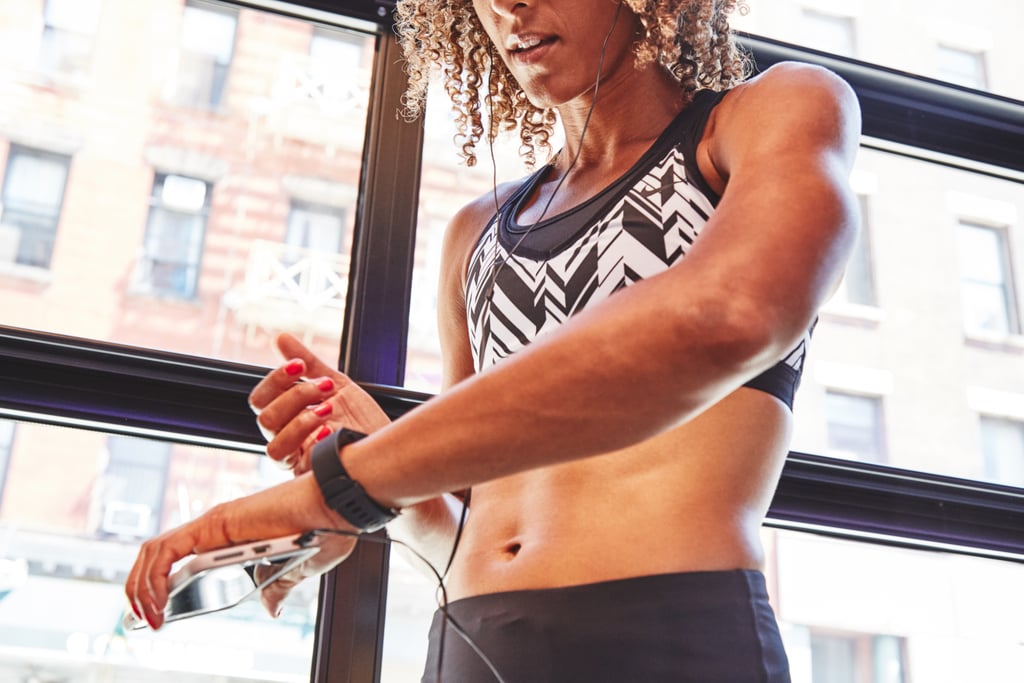
Don't trash your well-loved fitness tracker just yet! RD Julie Upton, cofounder of Appetite For Health, shares five ways your tracker can actually help with dropping pounds.
A recent study published in the
Journal of the American Medical Association reported that overweight participants in a diet study who wore fitness trackers
actually lost less weight, compared to those who followed the same diet
and exercise plan, albeit without any wearable monitoring devices.
While the dieters wearing trackers lost 7.7 pounds in two years,
those who didn't have fitness monitors lost 13 pounds. Even though
previous research has reported that wearable technology can motivate
people to help them lose weight, the authors of this study point out
that those studies were short-term and had limited participants.
Related Stories:
Nutritionist-Recommended Foods to Suppress Your Appetite Naturally
Beat Belly Fat: 5 Research-Proven Ways to Trim Inches From Your Middle
If you live by the data from your Fitbit, Jawbone, or other device, here are five ways to use it to help you peel off pounds:
Focus on Food First, Exercise Second
When it comes to losing weight and keeping it off, studies
consistently show that diet is more important than exercise. In fact,
trying to lose weight through exercise alone is a lousy idea because
food packs in so many many calories relative to what you burn off from
exercise. And, when it comes to behaviors associated with weight loss,
frequent weigh-ins, limiting or avoiding alcohol, and monitoring what
you eat are three common keys to success.
Avoid Food Rewards
How many times have you rewarded yourself after noticing how many
steps you had or how many calories you burned? Speaking to NPR, the lead
researcher of the
JAMA study, John Jakicic, PhD,
explained: "People would say, 'Oh, I exercised a lot today, now I can
eat more.' And they might eat more than they otherwise would have."
According to registered dietitian James Stevens, MS, RD, "Even though
trackers easily show you how many calories you've burned, they can't
tell you the other side of the energy balance equation — how many
calories you've eaten. You need to pay more attention to the 'calories
in' portion of the equation to see the scale budge. Just one or two poor
food choices can negate all the extra calories burned from exercise."
Instead, use non-food "rewards" to celebrate success, like a mani/pedi,
reading a chapter in a new book, taking a long bath, downloading new
music, or sleeping in!
Be More Mindful
According to Andreas Michaelides, PhD, chief psychology officer at
Noom Inc.
(a wellness app with a personalized coaching element), trackers alone
aren't the best way to help you achieve weight-loss success because
they're a passive approach to monitoring, so your brain doesn't fully
acknowledge your diet and exercise behaviors. "Being more involved and
mindful around eating and exercise is an important part of achieving
weight-loss success." To use your tracker in a more meaningful and
engaged way, use its web-based interface to download and monitor your
activity as well as your daily food intake
Personalize Your Device
For more accurate measures of activity and calories, be sure to enter
your age, sex, height, and weight into your tracker when setting it up.
These data impact the computations that trackers make to more
accurately determine calories burned. Also, as a general rule, wear the
device on your non-dominant arm/wrist, because research shows when
devices are worn on the dominant hand/arm, they may overestimate
activity and calories burned.
It's All Relative
Most monitoring devices — bathroom scales, diet trackers, gym
equipment, or wearable fitness trackers — have margins or error. The
best way to use data from any device is to consider it relative and
compare it to yesterday, last week, last month, or last year. If you see
that the scale isn't budging and can tell that your activity has
dropped or stalled — you know you need to move more (or eat less or
both) to peel off pounds.